Bowling Green was named in 1798 and incorporated in 1812. All 74 National Register listings with years, plus museums, hours and historic sites.
Last checked Oct. 12, 2026. History comes from the City of Bowling Green’s history pages; National Register listings come from the National Park Service’s list of listed properties (May 22, 2026, file). City Hall: 270-393-3000. Riverview at Hobson Grove: 270-843-5565.
How Bowling Green began
The city’s early history starts in 1775, when long hunters reached the Barren River and carved their names on beech trees. The first settlement, McFadden’s Station, was built on the north side of the river in 1778. Robert Moore built his cabin beside a large spring at what became Bowling Green in the early 1790s.
The General Assembly created Warren County by an act passed in December 1796 that took effect in March 1797. Robert Moore and his brother George gave two acres for a log courthouse and jail, on the site that is now Fountain Square Park, and the next year more than 30 acres for a town around it. At the first county commissioners meeting in early 1798, the settlers decided the town would be “called and known by the name of Bolin Green,” after the Bowling Green square in New York City. Bowling Green became the county seat in 1809 and incorporated in 1812.
The Maria Moore House on State Street, completed in 1818, is the oldest building in the city, according to the city (its history page spells it “Mariah”). By the 1830s, local companies were clearing the Barren River for steamboats and building the Portage Railroad from the docks into town. The Louisville and Nashville turnpike was finished in 1838.
Fountain Square and the historic downtown
Fountain Square Park is the old courthouse square. After the Civil War the county built a new courthouse elsewhere, and the city turned the square into a park, planned in 1870 by Mayor John Cox Underwood. Its first fountain was turned on April 23, 1872. The present cast fountain, crowned by a figure of Hebe, was bought from the J.L. Mott Ironworks of New York for $1,500 and installed in May 1881. Part of the first fountain stands on the back lawn of Riverview at Hobson Grove.
City Hall, at 10th Avenue and College Street, was designed by Louisville architect Brinton B. Davis and finished in 1908. John F. Kennedy spoke on its steps on Oct. 8, 1960, while campaigning for president. A time capsule buried in front of it on Sept. 16, 2008, is to be opened in 2108.
The Downtown Commercial District, roughly bounded by Adams and State streets and 8th and 10th avenues, was listed on the National Register in 1979.
Museums and historic sites you can visit
| Place | Address | Hours as published | Phone |
|---|---|---|---|
| Riverview at Hobson Grove | 1100 W. Main Ave. | Tue.-Sat. 10 a.m. to 4 p.m.; Sun. 1 to 4 p.m.; closed Mon. | 270-843-5565 |
| Kentucky Museum, WKU | 1472 Kentucky St. | Wed.-Sat. 9 a.m. to 4 p.m.; free | 270-745-2592 |
| Historic RailPark & Train Museum, L&N Depot | 401 Kentucky St. | March 23 to Dec. 31: daily, 10 a.m. to 4 p.m. | 270-745-7317 |
| National Corvette Museum | 350 Corvette Drive | 9 a.m. to 5 p.m. CT; check the museum’s page for the current days | 270-781-7973 |
| Lost River Cave | 2818 Nashville Road | Underground boat tours; book online | 270-393-0077 |
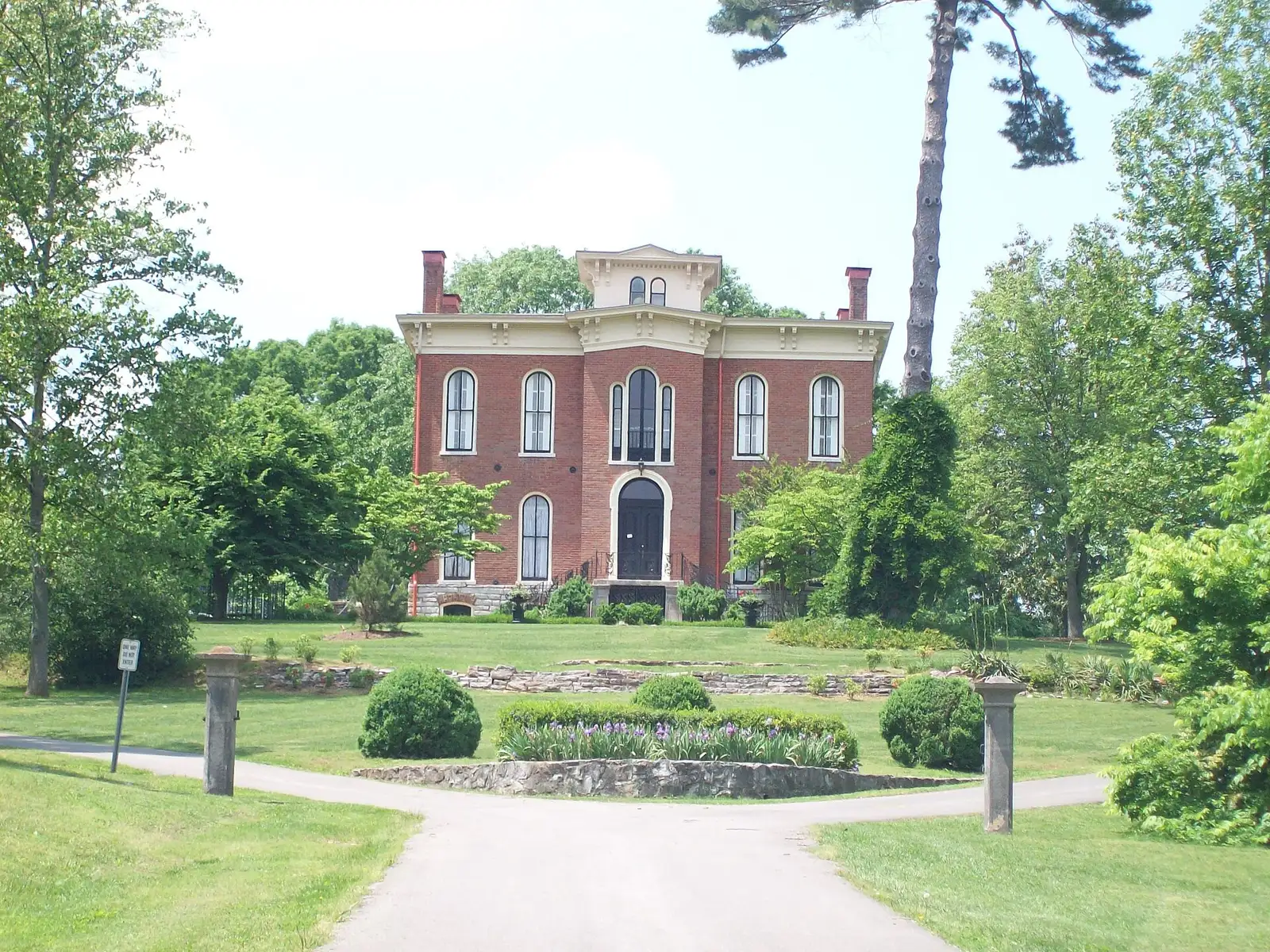
Riverview at Hobson Grove is Bowling Green’s only historic house museum. Its history page says work began in 1857, stopped when Confederate troops used the unfinished house to store munitions during the Civil War, and resumed under plans drawn in 1868. The Hobson family moved in by early 1872. The city acquired the property for a park after a 1965 fire, and the Friends of Riverview saved the house. Tours start at the top of the hour.
The Historic RailPark is in the L&N depot, listed on the National Register in 1979. The museum says it does not offer train rides. From Jan. 1 to March 22 it is closed Monday and Tuesday. The Kentucky Museum follows the WKU calendar.
Civil War forts and Fairview Cemetery
Three Civil War fortifications are on the National Register, all listed Dec. 5, 1984: Fort C.F. Smith on Reservoir Hill off East Main Street, Fort Lytle on the Western Kentucky University campus and Fort Webb off Country Club Drive. At Fairview Cemetery, the Confederate Monument of Bowling Green and the William F. Perry Monument were both listed July 17, 1997.
Every National Register listing in Bowling Green
The National Park Service list has 74 listings with a Bowling Green address. Thirty-five were added on Dec. 18, 1979. The state historic preservation office is the Kentucky Heritage Council. Most listed homes are private: view them from the street.
Districts
| Listing | Where | Year |
|---|---|---|
| Downtown Commercial District | Adams and State streets, 8th to 10th avenues | 1979 |
| College Hill District | College and Chestnut streets, 11th to 15th avenues | 1979 (enlarged 1996) |
| Upper East Main Street District | East Main and Elm streets | 1979 |
| St. Joseph’s District | Gilbert and Potter streets, Church and Brown’s Lock avenues | 1980 |
| Magnolia Street Historic District | Magnolia Street, Broadway to 10th Street | 1989 |
| Shake Rag Historic District | U.S. 31-W Bypass, Chestnut Street, East 5th Avenue and College Street | 2000 |
| Modern Automotive District | 538, 600 and 601 State St. | 2006 |
| Adams-Kentucky District | 900-1200 blocks of Adams Street, 1000-1300 blocks of Kentucky Street | 2008 |
Buildings, bridges and monuments in the city
| Listing | Address | Year |
|---|---|---|
| Riverview (Hobson House) | Hobson Grove Park | 1972 |
| Maria Moore House | 801 State St. | 1972 |
| St. Joseph Roman Catholic Church | 430 Church St. | 1975 |
| Lost River Archeological Cave | Address restricted | 1975 |
| Warren County Courthouse | 429 E. 10th St. | 1977 |
| Underwood-Jones House | 506 State St. | 1978 |
| Rauscher House (Webb Hotel) | 818 Adams St. | 1978 |
| W. H. Blakeley House | 1162 College St. | 1979 |
| Cecilia Memorial Christian Church | 716 College St. | 1979 |
| W. H. Everhardt House | 1223 College St. | 1979 |
| First Colored Baptist Church (State Street Baptist) | 340 State St. | 1979 |
| Grider House | 1320 Park St. | 1979 |
| Tobias Grider House | 864A Fairview Ave. | 1979 |
| Hall House | 104 W. Main St. | 1979 |
| Hines House | 1103 Adams St. | 1979 |
| Elouise B. Houchens Center for Women | 1115 Adams St. | 1979 |
| Louisville and Nashville Railroad Station | Kentucky Street | 1979 |
| Newton-Kemp Houses | 804-806 Chestnut St. | 1979 |
| Nine Hearths | 1244 Park St. | 1979 |
| Barren River L&N Railroad Bridge | Barren River | 1980 |
| College Street Bridge | Barren River | 1980 |
| Richardsville Road Bridge | Barren River | 1980 |
| St. James Apartments | 1133 Chestnut St. | 1984 |
| Fort C.F. Smith, Fort Lytle, Fort Webb | See above | 1984 |
| Confederate Monument; William F. Perry Monument | Fairview Cemetery | 1997 |
| Bowling Green OMS No. 10 | 719 Old Morgantown Road | 2002 |
| Pioneer Log Cabin | Kentucky Street near University Drive | 2004 |
| Milliken Building | 1039 College St. | 2010 |
| Standard Oil Company Filling Station | 638 College St. | 2010 |
| J.C. Givens House | 814 Covington St. | 2015 |
| Charles M. Moore Insurance Company | 1007 State St. | 2015 |
| L.K. Causey House | 936 Covington St. | 2015 |
| J.D. Dodson House | 943 Covington St. | 2017 |
| Bowling Green Flour Mill | 1239 Adams St. | Listed; no date in the NPS file |
On the WKU campus (all 1979): Cherry Hall, Health Buildings-Gymnasium, Heating Plant, Home Economics Building, Industrial Arts Building, Kentucky Building, President’s Home, Perry Snell Hall, Stadium (the Colonnade and amphitheater), Van Meter Hall, West Hall and Gordon Wilson Hall.
Outside the city center, with a Bowling Green address: Ironwood, Old Richardsville Road (1973); Samuel Murrell House, U.S. 31-W (1976); Curd-Moss House and A. C. Davidson House (1980); Drakes Creek Baptist Church, James F. Ewing House, James Kelley House, Kinlock, Merritt-Hardin House, Mount Olivet Cumberland Presbyterian Church, John Sloss House and Young’s Ferry House (1979); Walnut Lawn, Morgantown Road (1983); Jesse Kirby Springhouse, Love Howell Road (1987); Horse Shoe Camp, 8241 Louisville Road (1997); and the Hardcastle Store, 7286 Cemetery Road (2011).
Related guides
- Parks and trails in Bowling Green
- Things to do in Bowling Green this month
- Bowling Green population and growth
- Moving to Bowling Green
Frequently asked questions
When was Bowling Green, Kentucky, founded?
At the first Warren County commissioners meeting in early 1798, settlers named the new town around the county’s public buildings Bolin Green, the city’s history says. Bowling Green became the county seat in 1809 and incorporated in 1812.
How did Bowling Green get its name?
The city says it was named after Bowling Green, the square in New York City where patriots pulled down a statue of King George III during the American Revolution and used the lead to make bullets.
What is the oldest building in Bowling Green?
The Maria Moore House on State Street, completed in 1818, according to the city’s history. It was listed on the National Register of Historic Places in 1972.
How many National Register of Historic Places listings are in Bowling Green?
The National Park Service’s May 2026 list has 74 listings with a Bowling Green address, 35 of them added on Dec. 18, 1979.
What are the hours at Riverview at Hobson Grove?
10 a.m. to 4 p.m. Tuesday through Saturday and 1 to 4 p.m. Sunday; closed Monday. Tours start at the top of the hour. Call 270-843-5565.
Have your say